About Execution Capital
We have sat in every seat at this table.
Investor. Accelerator. Builder. Lawyer. Expert. Between us we have taken every position in an early-stage ecosystem, and seen the same thing from all of them: an enormous amount of goodwill, and no simple way to turn it into work that actually ships.
Chapter 01Where this comes from
Everyone here already wants the same thing.
Spend enough time in an early-stage ecosystem and you notice something that does not match the usual story told about it. Nobody is holding back.
Investors want their companies to win, and almost every one of them has far more to offer than the cheque — a network built over years, operators they trust, judgement earned the hard way. They are not short of generosity. They are short of a way to deploy it that does not come out of reserves or off the side of a partner’s desk.
Founders want more than money. Ask one what they actually need and you will rarely hear a number first. You will hear a person — someone who has already solved this, in the room, this quarter, not on a quarterly call.
Operators want their expertise to compound. The best of them are not looking for another day rate. They want to put their skill behind companies they believe in and hold something in what gets built, the way an investor does — and to do work that matters while they are at it.
Three groups, all wanting to help each other. All wanting to build things that count. And no straightforward way for any of it to happen.
That is what took five different seats to see clearly. The constraint is not goodwill; there is plenty of that. It is that no instrument exists for it.
Chapter 02What the numbers say
More founders than ever. Fewer rounds to go round.
We did not need data to know the problem existed — we had lived it. But the direction of travel in the UK and Europe is worth stating precisely, because it decides how urgent this is.
Put those three together and the picture is not a downturn. It is a concentration. Record numbers of people are starting companies. There are meaningfully fewer rounds available to them. And for the typical company, the amount raised has not moved.
A median seed round is £600,000. One senior hire can take a fifth of it before anything ships.
That is the arithmetic we set out to change. Not by arguing that founders should raise more — that is not in their gift — but by changing what a pound of runway can buy.
+60%
more people started companies in Europe in 2025 than in 2023 — over 27,000 founders, the highest of any year on record.
Atomico, State of European Tech 2025. Counts founders, not companies.
−27%
fall in UK seed-stage deals in 2025, to 704. Total UK equity deals fell 17% over the same period.
British Business Bank, Small Business Equity Tracker 2026.
£0.6m
median UK seed round in 2025 — flat on 2024. The average rose sharply, but only because a handful of very large rounds pulled it up.
British Business Bank. Median £0.6m; average £3.2m.
Chapter 03We tested it before we sold it
Consilience Ventures, 2019 to 2025.
The obvious objection to any new instrument is that it works on a whiteboard. So before Execution Capital existed, the model ran for six years inside a working network.
Consilience Ventures assembled a network of over 300 vetted senior professionals and put them to work inside portfolio companies, paid partly in cash and partly in units of a shared vehicle rather than in equity in the individual company. Companies were backed alongside institutional co-investors. It ran through a full cycle, including two years most early-stage investors would rather forget.
Six years is long enough to find out which parts of an idea survive contact with reality.
What it proved
The parts that held
Senior operators will take a portfolio unit instead of a full cash rate, when the portfolio is real and the selection is credible. Companies will commit economic rights for execution they can actually use. A network of that seniority can be assembled and kept engaged. And the governance templates work.
What it exposed
The parts that did not
Scoping by conversation does not scale — work needs acceptance criteria written before it starts. Unit pricing set case by case creates quiet unfairness between early and late participants. And an instrument without a published policy behind it is a permanent negotiation.
Chapter 04Why we did not keep it
A model that only works for one network is a hobby.
We could have run one network and kept the mechanism to ourselves. It was working. That is what most people would have done with it.
The first reason is that the problem is not ours — it belongs to every fund with a portfolio it cannot properly support, and every founder holding a round that will not stretch.
The second is that a single network cannot generate the thing that makes the model compound. One network is a proof point. Many networks, each run by a builder with their own thesis and their own standards, is infrastructure.
So we took the mechanism apart, wrote down every rule that had been a judgement call, and rebuilt it as something another VC could run under their own name. The point was never to run the best network. It was to make the mechanism ordinary.
Chapter 05What we actually believe
Every fund should have a platform function. Almost none can afford one.
The largest funds solved portfolio support years ago by hiring for it. It works, and it is one of the clearest advantages large funds hold over small ones.
For everyone else, the question is not whether a platform function would help. It is what you would have to put down in order to build one.
Building an execution layer is not one more project. It is a second business. You need the idea first, then everything you needed in order to build the fund, a second time.
01 Support
Capability without payroll
- Senior execution available to every company in the portfolio, not only the ones a partner has time for
- Paid for out of committed upside rather than the management fee or follow-on reserves
- Scoped, verified and settled the same way every time
02 Transparency
Evidence instead of assertion
- Every engagement dated, scoped and signed off by both sides as it happens
- LP reporting that is a by-product of the transaction
- Portfolio companies see the same record their investor sees
03 Data
Decisions that can be checked
- Structured execution data rather than sentiment gathered on a call
- A shared maturity scale across a whole portfolio
- The clean, consented record that any useful AI application in this industry will require
Chapter 06Who is building it
Three people who have each been on a different side of this.
The seats in Chapter 01 are not a metaphor. They are the three CVs below.


Martin W Cornish
Co-founder & General Counsel
Over thirty years as a financial services lawyer specialising in securities, derivatives, compliance, asset structuring and regulatory frameworks, with deep FCA and cross-border experience. He is the reason the instrument design, the segregated portfolio architecture and the ecosystem legal layer are built to institutional standard rather than improvised.
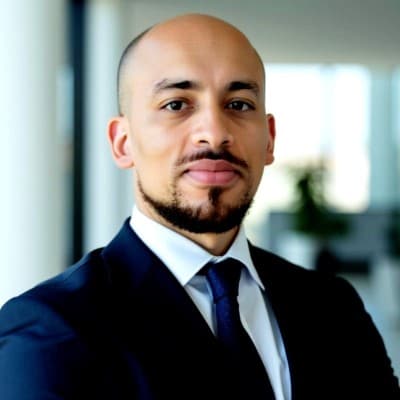
Aurelien Caristan
Co-founder & CTO
Fifteen years across finance and technology, architecting scalable, secure and resilient platforms for complex financial workflows and investment infrastructure — the Ticket workflow, the settlement rails, Proof-of-Execution reporting and the valuation monitoring that a published pricing policy depends on.
Where this goes
Execution should not be the privilege of the best-funded company in the room.
It is the thing that decides whether any of it works, and right now it is allocated by whoever raised the most. We think that is worth changing, and we have spent six years finding out whether it can be.